
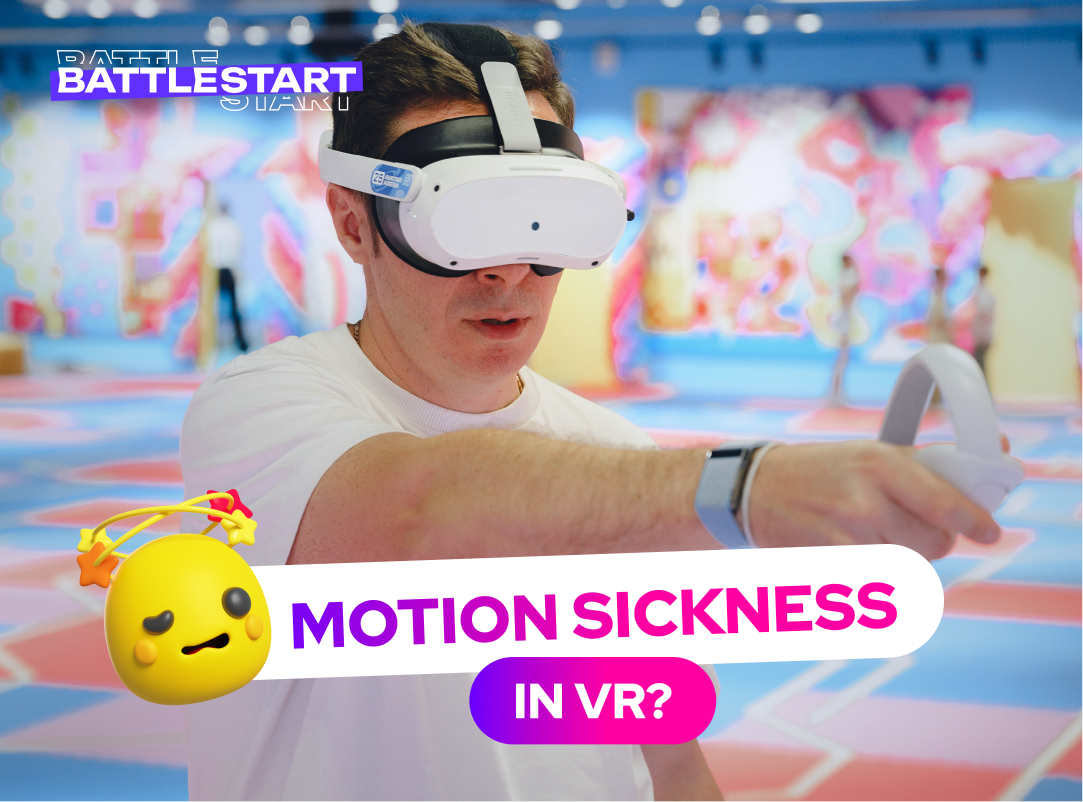
For many, their first foray into virtual reality was a mix of wonder and disappointment. The initial "wow" factor of immersion was often cut short by an unpleasant physical reality: VR-induced motion sickness (VIMS). This widespread issue, characterized by nausea, dizziness, and discomfort, became a significant barrier, preventing countless potential users from fully enjoying VR.
Good news! It wasn't you, it was 60 FPS.
At BATTLE START, we identified the root of this problem and engineered our free-roam VR games around a pivotal technical solution: a 72 FPS (Frames Per Second) standard. Here’s why this specific frame rate is a game-changer for comfort and accessibility.
Good news! It wasn't you, it was 60 FPS.
At BATTLE START, we identified the root of this problem and engineered our free-roam VR games around a pivotal technical solution: a 72 FPS (Frames Per Second) standard. Here’s why this specific frame rate is a game-changer for comfort and accessibility.
The Core of the Problem: Frame Time — What Your Brain Actually Feels
To understand why 72 FPS makes a difference, we must look beyond the raw frame count and examine frame time—the actual time elapsed between each displayed image, measured in milliseconds (ms).
Why frame time? Because your brain doesn't count frames per second; it senses the delay between visual updates. This delay is the direct cause of the mismatch between what you see and what you feel. A shorter frame time means the virtual world updates faster, staying in sync with your body's own sense of motion.
60 FPS = 16.67 ms between frames (the problematic standard)
72 FPS = 13.89 ms between frames (our solution)
The jump from 60 FPS to 72 FPS reduces this critical delay by 2.78 ms. While this may seem minor, in the world of VR, it's revolutionary. This reduction brings the visual update rate significantly closer to the brain's processing speed, minimizing the perceptual mismatch between what your eyes see (virtual movement) and what your inner ear feels (physical stillness). This mismatch is the primary cause of motion sickness.
Why frame time? Because your brain doesn't count frames per second; it senses the delay between visual updates. This delay is the direct cause of the mismatch between what you see and what you feel. A shorter frame time means the virtual world updates faster, staying in sync with your body's own sense of motion.
60 FPS = 16.67 ms between frames (the problematic standard)
72 FPS = 13.89 ms between frames (our solution)
The jump from 60 FPS to 72 FPS reduces this critical delay by 2.78 ms. While this may seem minor, in the world of VR, it's revolutionary. This reduction brings the visual update rate significantly closer to the brain's processing speed, minimizing the perceptual mismatch between what your eyes see (virtual movement) and what your inner ear feels (physical stillness). This mismatch is the primary cause of motion sickness.
The Numbers Speak: A Statistical Leap in Comfort
Data from VR studies and industry experience clearly show that the jump from 60 Hz to 72 Hz (and the corresponding stable frame rates of 60 FPS to 72 FPS) is a critical comfort threshold. Research on simulator sickness identifies a critical threshold around 72 frames per second — the point where the perceptual mismatch for the brain significantly decreases.
At a steady 60 FPS, the statistics are stark: 30–80% of users experience motion sickness, with the risk leaning toward the upper limit (80%) in active, free-roam scenarios that demand full-body movement. This vulnerability was the Achilles' heel of the first generation of VR. By designing our games to deliver a 72 FPS, we target the proven comfort zone. The result shifts the paradigm: for the vast majority of users, a smooth 72 FPS experience becomes comfortable and sustainable, effectively moving the accessibility rate from a risky 20-70% to well over 90%.
At a steady 60 FPS, the statistics are stark: 30–80% of users experience motion sickness, with the risk leaning toward the upper limit (80%) in active, free-roam scenarios that demand full-body movement. This vulnerability was the Achilles' heel of the first generation of VR. By designing our games to deliver a 72 FPS, we target the proven comfort zone. The result shifts the paradigm: for the vast majority of users, a smooth 72 FPS experience becomes comfortable and sustainable, effectively moving the accessibility rate from a risky 20-70% to well over 90%.
Why 72 FPS, Not 90 or Higher?
Modern VR headsets often tout 90Hz or 120Hz refresh rates, ideal for plugged-in experiences.
However, for true free-roam VR — where complete freedom of movement is everything — a different standard is needed. Our VR games are engineered for 72 FPS, specifically for untethered, battery-powered play. This high frame rate delivers the critical smoothness for comfort and rock-solid performance on mobile hardware, making the immersive, full-body adventure truly lifelike.
Uncompromised Performance: A 72 FPS standard is more achievable on the powerful, yet mobile, hardware inside standalone VR headsets used for free-roam experiences. This allows us to dedicate more system resources to higher graphical fidelity, greater detail, and stable supersampling, making the virtual world more convincing and visually rich.
Critical Responsiveness: Free-roam games are intensely physical. Players duck, sprint, and turn rapidly. 72 FPS ensures near-instantaneous response to every movement. The lower frame time (13.89 ms) means less input lag, creating a seamless bond between player action and on-screen reaction. This preserves a high tempo and is crucial for competitive, active gameplay.
However, for true free-roam VR — where complete freedom of movement is everything — a different standard is needed. Our VR games are engineered for 72 FPS, specifically for untethered, battery-powered play. This high frame rate delivers the critical smoothness for comfort and rock-solid performance on mobile hardware, making the immersive, full-body adventure truly lifelike.
Uncompromised Performance: A 72 FPS standard is more achievable on the powerful, yet mobile, hardware inside standalone VR headsets used for free-roam experiences. This allows us to dedicate more system resources to higher graphical fidelity, greater detail, and stable supersampling, making the virtual world more convincing and visually rich.
Critical Responsiveness: Free-roam games are intensely physical. Players duck, sprint, and turn rapidly. 72 FPS ensures near-instantaneous response to every movement. The lower frame time (13.89 ms) means less input lag, creating a seamless bond between player action and on-screen reaction. This preserves a high tempo and is crucial for competitive, active gameplay.
The BATTLE START Philosophy: VR Should Be for Everyone
For us, player comfort is not an afterthought—it is as fundamental as an engaging story or exciting gameplay. We believe that the future of virtual reality depends on inclusivity. By building our games on a 72 FPS foundation, we answer the historical pain point that once made VR inaccessible to so many.
Time to Fall in Love with VR!
If you’ve had a negative VR experience in the past, if you believe motion sickness is an insurmountable barrier — we urge you to find a BATTLE START arena and try again. Chances are high that you won’t just change your mind, but become a true fan of free-roam virtual reality games.
Who knows? After that, you might even decide to build your life around BATTLE START.
Becoming our partner is easier than you think. Just like falling in love with VR.
Who knows? After that, you might even decide to build your life around BATTLE START.
Becoming our partner is easier than you think. Just like falling in love with VR.

